Cinema at the Frontline: The Oscars in the Era of Perpetual Conflict
The 2026 Oscars, the 98th Academy Awards, took place on March 15, but this year the ceremony felt less like a celebration and more like a reflection—an echo of a world caught in a relentless chain of crises. From the war in Ukraine to the devastation in Gaza, and the escalating tensions between Iran, Israel, and the United States, the global landscape has shifted into a state where conflict no longer appears as an exception, but as a recurring condition.
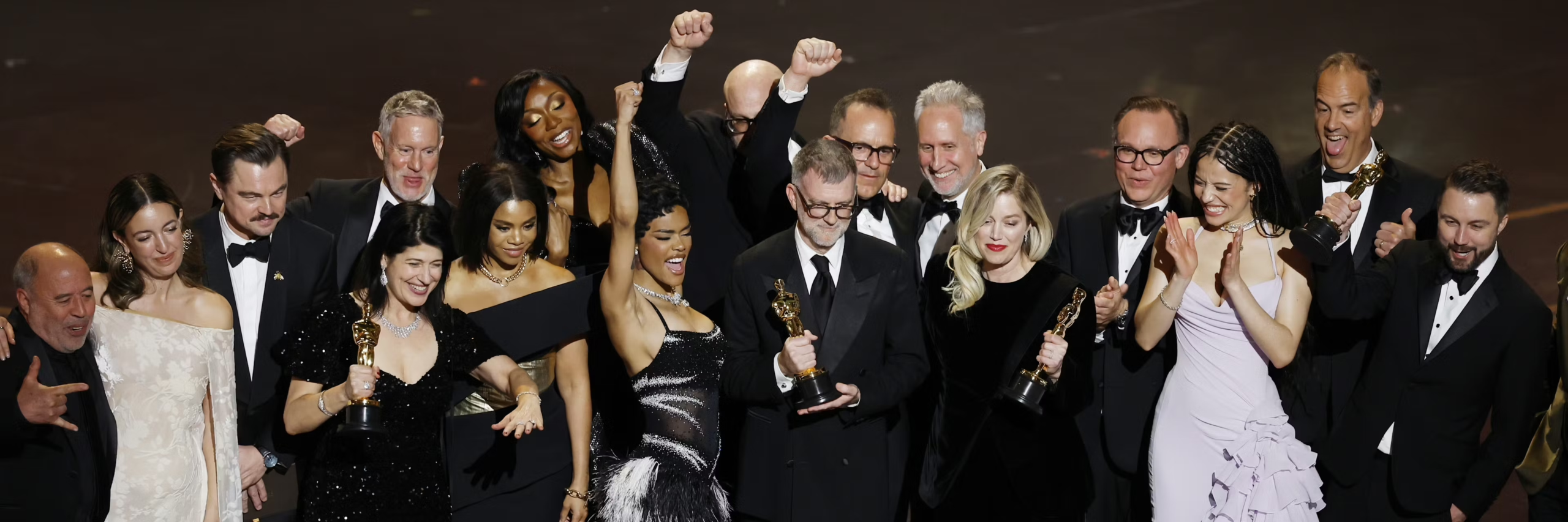
© Chris Torres/EPA
Within this context, the title of the night’s biggest winner, One Battle After Another, resonated far beyond cinema. It seemed less like a film title and more like a diagnosis of the present moment. The Oscars, in this sense, became a space where cinema did not merely present stories, but quietly absorbed and refracted the psychological weight of a world defined by continuous unrest.
Winning six awards, including Best Picture and Best Director for Paul Thomas Anderson, One Battle After Another stood at the center of the ceremony. Yet its achievement is not without tension. The film attempts to navigate the complexity of human experience under pressure, but at times becomes entangled in its own density.
In the acting categories, Michael B. Jordan in Sinners by Ryan Coogler and Jessie Buckley in Hamnet by Chloé Zhao delivered performances that sought to capture the inner fractures of individuals shaped by external pressures.
The international feature category revealed perhaps the most direct engagement with the fractures of history and politics: The Secret Agent by Kleber Mendonça Filho reconstructs the atmosphere of Brazil’s military dictatorship in the 1970s. It Was Just an Accident by Jafar Panahi reflects a lived reality shaped by interrogation and constraint, though its strong emphasis on personal perspective sometimes narrows the film’s narrative scope. Sentimental Value by Joachim Trier approaches conflict from an intimate angle, focusing on memory and family, though its reliance on dialogue occasionally slows its cinematic momentum. Sirât by Oliver Laxe follows a father and son searching for a missing daughter, though parts of the narrative feel familiar. The Voice of Hind Rajab by Kaouther ben Hania presents one of the most immediate confrontations with war, though its narrow scope limits its dimensionality.
What ultimately distinguishes the 2026 Oscars is not only the films themselves, but the historical moment they inhabit.
Cinema, inevitably, reflects this shift. The Oscars become more than an awards ceremony; they transform into a cultural register of a world struggling to make sense of itself.
In the end, the 2026 Oscars offered a striking image: cinema standing at the frontline, observing and responding to a reality defined by perpetual conflict.
Majid Movasseghi
j:mag Tous droits réservés
