The Patience of Seeing—Béla Tarr and the Cinema of Endurance
There are films that you watch and soon forget. And there are films you experience with your entire body. The works of Béla Tarr belong to the latter category. They demand patience, time, and a willingness that has become rare today: to remain with the image, even when it seems to have nothing left to tell.
My first encounter with Tarr’s films was accompanied by a strange fatigue. Not a fleeting exhaustion, but a weariness that slowly settled in my body – in the eyes, the shoulders, the breath.
The long takes seemed endless. People walked, the wind blew, rain fell. And yet, in the conventional sense, nothing seemed to happen. Still, something held me. Not the story, not the tension or the dramaturgy, but a peculiar presence.
Slowly, I began to understand: these films do not ask you merely to follow them. They ask you to stay with them.
In Tarr’s cinema, the camera does not hurry. It explains nothing; it seeks no punchline. It simply walks alongside people – alongside weary bodies, alongside faces where hope glimmers faintly. The pain this cinema conveys is not dramatic. It is a quiet, chronic state, one that you must learn to live with.
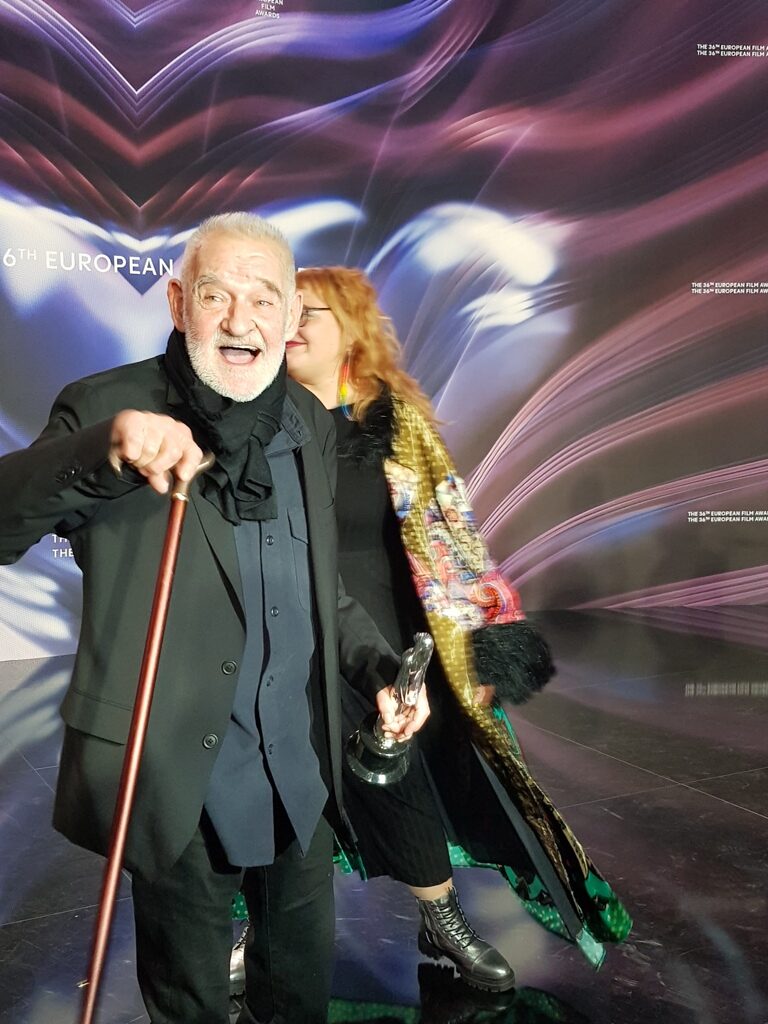
© Malik Berkati
As the shots grow longer and time seems heavier, Tarr appears to impose a simple condition on the viewer: If you want to stay here, you must really stay. Watching Sátántangó (1994), this experience becomes particularly vivid. In one famous shot, the camera follows a group of people slowly crossing a muddy landscape. Step by step, they move forward, without a clear destination. Here, movement does not signify progress – only continuation.
Another scene from the same film takes place in a tavern. Villagers dance to the same repetitive music. They spin in circles, drink, laugh, stagger. The camera moves slowly among them, observing their bodies. What first appears as a moment of joy gradually transforms into something else: an endless loop of alcohol, fatigue, and despair.
In Werckmeister Harmonies (2000), movement becomes a silent choreography. People arrange themselves in space as if invisible forces dictate their paths. Tarr observes these movements with a patience rarely seen in contemporary cinema.
When I think of Tarr, Tarkovsky’s Stalker (1979) often comes to mind. Not just because of the long takes or the silence, but because of the act of walking itself. There too, characters enter a space with its own rules – a space that demands submission to its rhythm. Yet here lies a crucial difference. Tarkovsky’s world still holds the possibility of meaning. Even if salvation does not arrive, the potential remains. Tarr’s world seems to have left that potential behind.
In Stalker, water, sounds, and the landscape carry a hidden significance. At the end, you feel that something within yourself has shifted. In Tarr’s films, however, often only a deep fatigue remains. But this fatigue is not empty. It is a quiet confrontation with a simple truth: The world owes us nothing.
Perhaps nowhere is this stance more evident than in The Turin Horse (2011). The wind almost never ceases. It beats against the house, against the figures, against the landscape. Day after day, the same actions repeat: rising, eating potatoes, going out, returning. Life is reduced to a few gestures. The wind seems to permeate everything, as if itself a sign that this world offers no solace.
Tarr’s cinema is built on a radical assumption: that humans are ultimately alone. Neither hero nor tragic victim, just a human being existing in an indifferent world. His camera rescues no one and condemns no one. It remains. It observes.
Perhaps there is an ethical stance in this very act of staying.
When it became known that Tarr would make no films after The Turin Horse, I was not surprised. That film feels like a conclusion. The wind continues to blow, the meals repeat, the light grows dimmer, and life slowly fades.
Tarr is not dead. Yet his cinema, at some point, chose silence. Perhaps because the world he depicted no longer needed new images. Or perhaps because any continuation would have been a betrayal of the suffering he had so carefully captured.
Tarr’s films remind us that seeing is not always a comfortable experience. Sometimes, seeing simply means staying – alongside those for whom no one else has patience.
And perhaps, in an age where everything is meant to be fast, compact, and consumable, this very act of staying is itself a form of resistance.
In Tarr’s cinema, one does not merely stay; one survives in the silence.
Majid Movasseghi
j:mag Tous droits réservés
