Berlinale 2026 — In the Dark, Between Fracture and Understanding
For me, a festival does not begin with light.
It begins with darkness.
With that moment when the house lights fade and no image has yet touched the screen. I hold my breath. I do not know what will break first: the silence of the room or my own certainties.
Early morning trains. Too little sleep. Long coffee lines. Moving from one screening to another. Writing. Comparing. Thinking.
I do not attend the Berlinale for entertainment. If I wanted comfort, I would stay home. I enter the darkness to learn — perhaps from a precisely placed camera, perhaps from a cut, perhaps even from a mistake.
I learned cinema in the tradition of dialectics: thesis, antithesis, synthesis. If that movement does not occur within a film, if the camera does not know its place, if form fails to generate meaning, no real connection emerges — even if the film wins an award.
Berlinale 2026 unfolded in a world far from calm. The opening film, No Good Men, a German-Afghan drama by Shahrbanoo Sadat about identity and loyalty in a fractured reality, made it clear that the festival would not turn away from the world.
But for me, the essential question was not whether films are political. It was whether politics becomes lived human experience — or remains a slogan.
In that atmosphere, the jury president’s remarks about distancing cinema from politics sparked debate. He spoke of empathy rather than instrumentality. Some artists protested. Others criticised the festival’s silence. What interested me was not the headline, but the tension within the question itself: Can cinema truly distance itself from politics when the world itself breathes politically?
The films offered my answer.
When Yellow Letters by İlker Çatak won the Golden Bear, I was not surprised. The story of an artist couple marginalised and silenced because of their convictions felt painfully familiar. Sitting in the theatre, I thought: this is not only Turkey. I know this atmosphere. As an Iranian, I have not only analysed totalitarianism — I have experienced it.
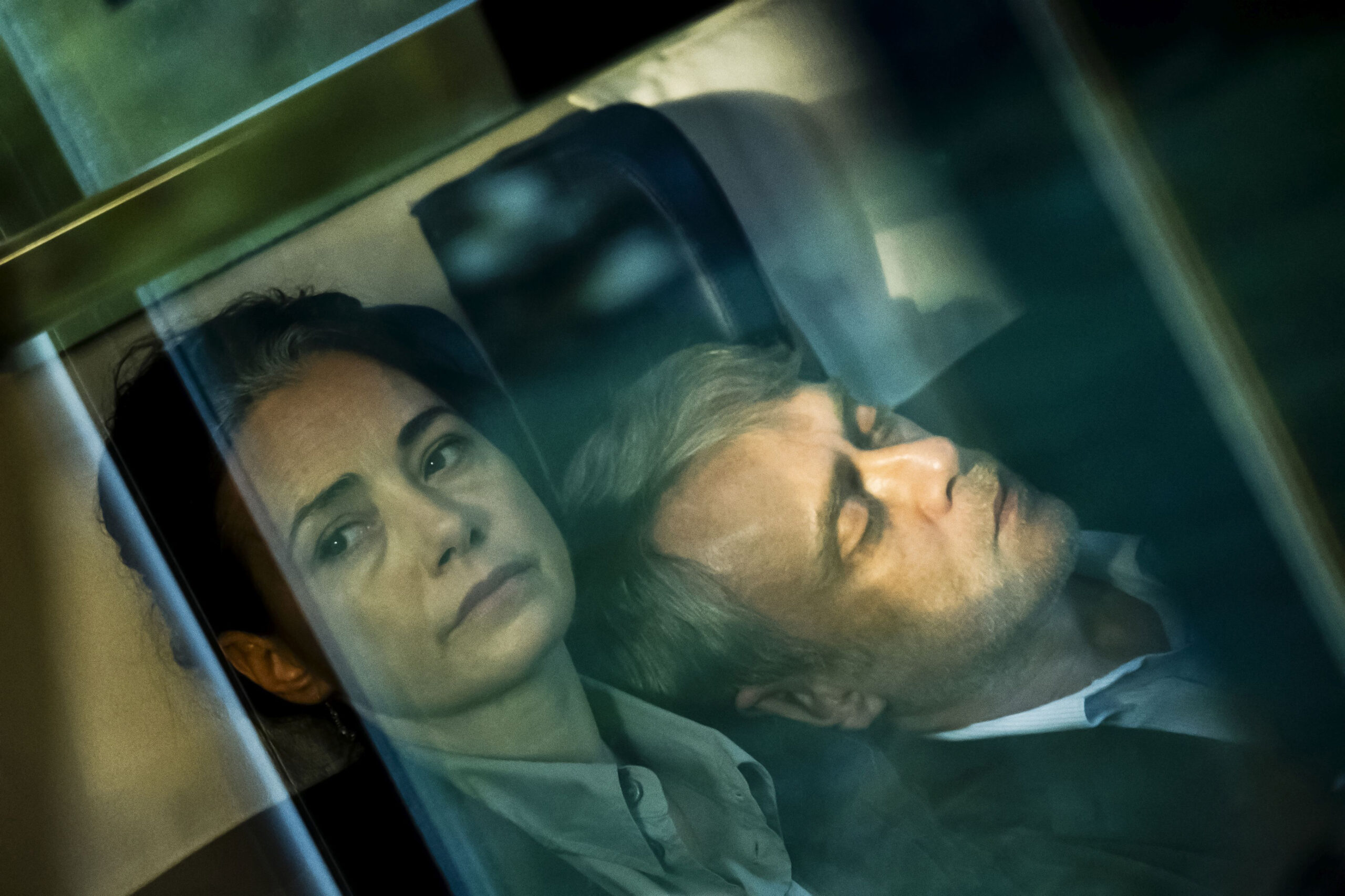
© Ella Knorz, ifProductions, Alamode Film
Yet the film’s strength was not merely thematic. It was formal.
The frames often felt half-empty — walls stripped of posters, an atelier drained of warmth. Yellow was not a warning but a slow erosion, a fading of presence. The camera was never restless; it seemed to know precisely how long to remain still. Each silence thickened the space. Suppression did not explode — it evaporated.
And perhaps the most devastating moment was not the act of censorship itself, but the instant when the couple, sitting across from one another, no longer knew whether they were resisting the world or simply clinging to an image of themselves. Belief, exclusion, doubt — the dialectic completed itself without proclamation. Politics was woven into intimacy, not declared. That synthesis made its recognition inevitable.
Salvation by Emin Alper approached violence differently. The central event — an act of social brutality — was never fully shown. We encountered it only in fragments: in hesitant testimonies, in glances that refused to settle. The film seemed less interested in justice than in narrative — how communities construct versions of truth before any court convenes.
Faces lingered in long takes, not for tears but for hesitation. Guilt circulated without a clear owner. In the end, salvation did not arrive as forgiveness, but as the courage to remain within ambiguity. It was a moral film precisely because it refused moralism.
Queen at Sea by Lance Hammer unfolded like a tide. Alzheimer’s was not treated as a medical condition but as geography — an ocean slowly redrawing the coastline of a relationship. Waves returned again and again, erasing footprints from the sand. Love shifted shape: from dialogue to care, from reciprocity to vigilance. Time stretched. Scenes breathed longer than expected. If there was politics here, it resided in tenderness — in the fragile economy of attention between two people when memory begins to dissolve. The sea did not symbolise loss; it enacted it.
Everybody Digs Bill Evans by Grant Gee transformed music into cinematic structure. It resisted the safety of biography. Instead, it moved like improvisation: a theme introduced, abandoned, rediscovered. Editing carried the rhythm of a jazz phrase — pauses that felt like inhalations, cuts that landed like chords slightly off the beat.
The film did not explain music; it became music. Image and sound pulsed together as if sharing one bloodstream. Narrative gave way to tempo. Watching it, I felt that cinema had briefly remembered its own capacity for syncopation.
Josephine by Beth de Araújo asked a quieter question: what does it mean to witness? Its camera often observed from thresholds — through windows, across streets, behind glass. We were never entirely inside the scene. The distance implicated us. To see is not neutral. The film seemed to suggest that spectatorship carries responsibility. By withholding dramatic resolution, it turned the gaze back onto the audience. Are we merely observers, or do we participate in the silence we condemn?
And then there was Yo (Love Is a Rebellious Bird) by Anna Fitch and Banker White — one of the festival’s true discoveries for me. Minimalist, suspended between documentary and fiction, it followed what appeared to be an almost ordinary intimacy: two people, sparse conversations, gestures so slight they risked disappearing.
There was no stylisation to protect them. The camera did not beautify. It remained present — patient, exposed. Each touch felt precarious, as though love itself were a fragile creature that might take flight at the slightest intrusion. The boundary between reality and performance dissolved not through artifice but through restraint. Courage, here, meant allowing vulnerability to remain unadorned.
Not all films reached this level. Out of more than twenty screenings, I left only one early — and that very film later received a critics’ award: Soumsoum, la nuit des astres by Mahamat-Saleh Haroun. That raises questions.
Aesthetics is not only intention; it is structure. Not only conviction, but form. A film may shout the correct slogans and still fail to generate movement. Without inner dialectics, even urgency becomes static.
Sections such as Forum or Panorama often felt braver than the main competition. There, imperfection was not concealed. Durations stretched. Narratives fractured. Risks were visible. Some films felt unfinished — but alive. In those spaces, I sensed cinema thinking aloud, still uncertain, still searching for synthesis.
Amid all this, Switzerland played a quiet yet meaningful role. While no Swiss film appeared in the main competition, its presence was tangible in Panorama, documentary strands, and especially within the European Film Market. Co-productions, networks, funding structures — Switzerland often operates not in the spotlight, but within the framework itself. Its influence lies in dialogue, partnership, and the subtle architecture of European cinema.
Walking through Berlin’s cold streets at night, I return to that first moment before the image.
Cinema, for me, is not a place of comfort.
It is a place of inquiry.
Berlinale 2026 was neither purely political nor purely aesthetic.
It stood in the tension between the two.
And perhaps that is precisely its strength:
in a darkness that does not merely allow us to see — but compels us to think.
Majid Movasseghi, Berlin
j:mag Tous droits réservés
